

Curriculum
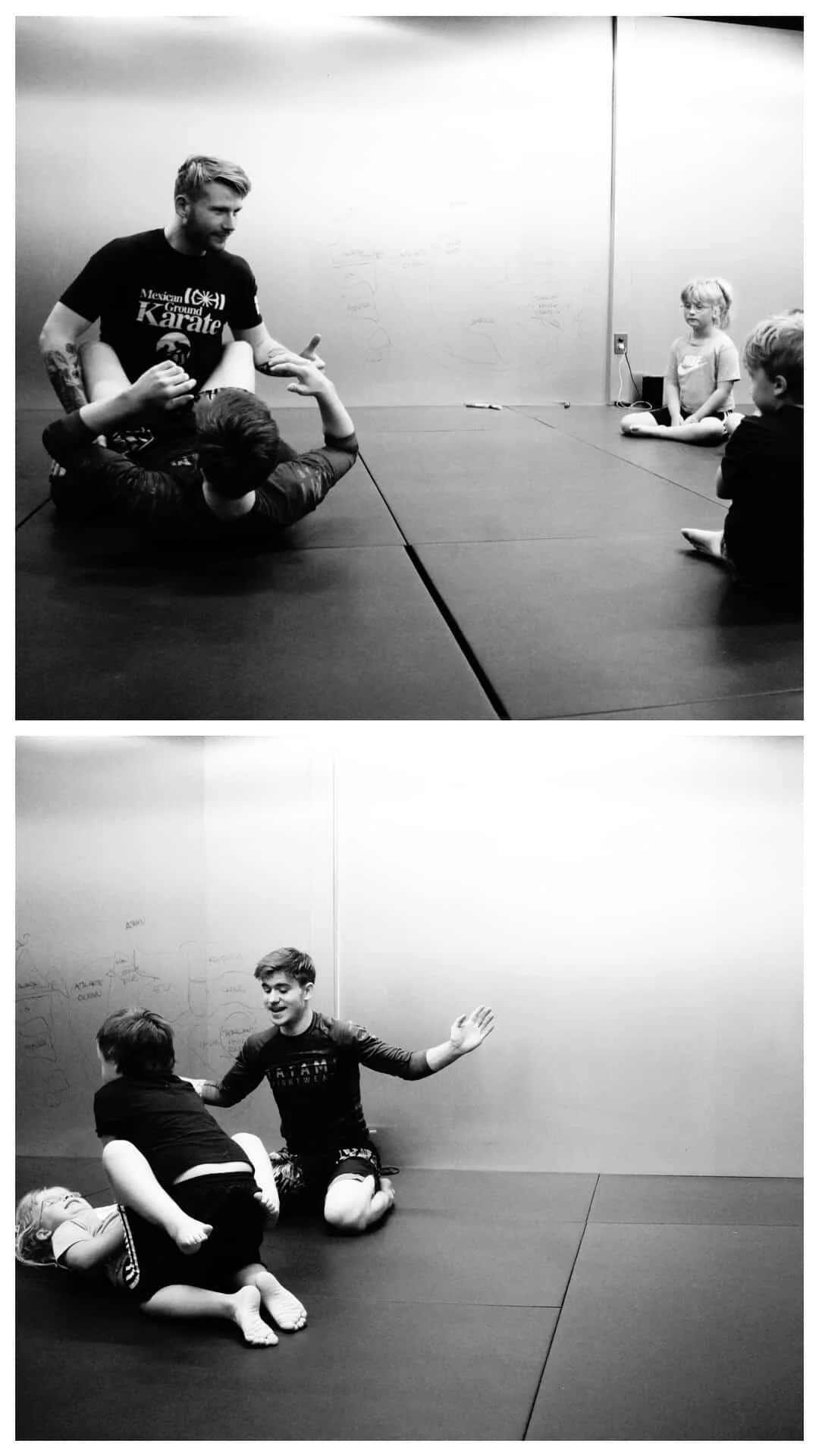
I don’t agree with teaching fluff.
As somebody that has spent my whole life studying martial arts, I can confirm. There is plenty out there.
Everything we teach needs to be proven, reliable, and trustworthy.
I will not teach anything that I don’t believe is effective in sport or self defence.
No 90’s action movie wrist twisting nonsense.
Just Jiu-Jitsu that you can trust.
What We Practice Is What We Perform
How we train is just as important as what we train.
Here are a few of the ways we break down the process of learning.
Blending these styles of teaching helps to keep each lesson valuable despite level or experience.
Style Of Training
-
This is the way Jiu-Jitsu has primarily been taught traditionally.
We demonstrate a technique, students practice that technique.
Static drilling is the fastest way to develop the essential movement, but needs to be reinforced with other styles of learning, as it doesn’t usually face resistance.
-
Ecological drilling is essentially learning by doing.
Students are given a goal, a problem to solve, and a resisting partner. This allows them to explore solutions while developing the timing, reactions, and decision-making needed for live Jiu-Jitsu.
-
Students are out into disadvantageous positions against resistance partners.
This is the best way to develop smart decision making and panic control when in defensive situations.
-
The Jiu-Jitsu equivalent of sparring.
Partners grapple without any restriction, aiming to control or submit one another.
This allows students to feel how positions and attacks flow together, and is overall the best way to judge a student’s proficiencies and weaknesses.

Why We Train Without The Gi
-
Gi Jiu-Jitsu is a completely different style, and respectfully, No-Gi is fundamentally more useful across a broader number of situations
The ability to use Gi grips to stall out an opponent (especially when a size advantage is present) is a habit people get far too reliant on. And, it makes training far more challenging for smaller people.
Especially in situations of self defense, I’d rather my team be prepared with techniques that will work regardless of apparel.
-
The No-Gi Jiu-Jitsu market is constantly Expanding.
Competitions are held frequently, giving students the opportunity to compete (should they choose to) and develop very quickly.
Every year, the amount of people that make a living through competitive Jiu-Jitsu increases.
-
I don’t want to charge a brand new student $150 for an academy Gi.
Then we train 3 days a week. Are you going to do laundry after every class? Or are you going to go buy another 2 gi’s for another $150 each.
It’s annoying, it’s expensive, and I don’t want that.
The Early Steps
The Goal Of A Beginner….
-
Defense in Brazilian Jiu-Jitsu is all about the small details, like maintaining strong frames to create space and control your opponent’s pressure. These subtle movements might seem minor, but they’re crucial in preventing your opponent from advancing position or applying submissions. Proper framing helps protect your neck, arms, and hips while giving you leverage to escape or counterattack. Mastering these small defensive techniques builds a solid foundation that transforms your overall game, turning what feels like reactive moves into proactive control. In BJJ, defense is never passive—it’s a strategic art of setting up your next opportunity.
-
Control is the foundation of our ability to retain friendly partnerships and grow as a team.
Firstly, we must learn to control our physical body, to apply techniques properly without risking injury to our teammates. Furthermore we have to control our mind as well.
We have to control our stress and learn to stay composed when faced with adversarial positions and attacks. Also to control our temper and pride when we tap and submit.
Control is to be practiced at all levels, by all students.

Intermediate Advancement
-
In Brazilian Jiu-Jitsu, every move has a counter waiting to be discovered, making the art an endless chess match of technique and timing. The beauty lies in the nuance—what looks like a simple escape or reversal often requires countless repetitions to master the subtle shifts in balance and pressure. Over time, as you roll and drill, you begin to read your opponent’s intentions before they fully unfold, allowing you to smoothly transition from defence to offence. This dance of moves and counters is what makes jiu-jitsu both challenging and endlessly rewarding.
-
Advancement is the successor to control.
Being able to control a position is important, but the magic lies in being able to maintain that control while climbing to more dominant positions.
Concepts like base, inside position, and pressure are especially important as they minimize the risk of a counter sweep or attack.
-
“The right move at the wrong time is still the wrong move.”
Timing comes with personal experience, because timing is essentially prediction, and to make educated predictions, we must subconsciously recognize our opponents patterns.
It’s a great factor to judge whether a student has entered the intermediate level.

Mastery
-
Strategy combines the practices of prediction and pattern recognition to formulate a multi tiered plan of attack. A strategic player has the ability to lead their opponents into situations where they can be countered, and then attacked.
To formulate a proper strategy, a student must have a deep understanding of the equation from both the perspective of themselves and their opponent, making it a symbol of high level grappling.
“Strategy without attack is the longest road to victory. Attack without strategy is the sound before defeat”.
-
Flow is very much a mental quality. It is when a player has reached such proficiency, that they can move subconsciously relying on instinct without pause.
Flow is built over hours in both static drills and rounds of rolling (sparring),
-
Patience is a virtue in life and sport.
A new student needs patience to separate their losses from their person, ensuring longevity by combatting unhealthy self criticisms.
An experienced student needs patience to apply techniques at the proper time, without rushing and potentially losing position.